
• About Ed Boris
  • Contact details
  • Linkedin Profile

Ed Boris

~ Expert in digital transformation

Ed Boris

Tag Archives: Black Friday

Get Ready because Black Friday this year is going to be Bloody Friday.

11 Wednesday Nov 2015

Posted by Edouard Boris in Business Continuity, Cloud, Digital Transformation, SAAS, SmartSourcing

≈ Leave a comment

Tags

Black Friday, Capacity Management, Retail, saas

All the major retailers in the UK are prepared and are announcing their Black Friday super productions:

The Award for the Best Comedy goes to Tesco!

Screen Shot 2015-11-10 at 21.08.37

Last year I wrote a post on “Taking orders is great but how about delivering on time and on quality?”. It is pretty hilarious but Tesco have already given up.

They announce that “Due to unexpected high demand all deliveries will take 5-7 days” and “Express delivery is currently unavailable”.

No, you are not dreaming, today 11th November, 16 days before Black Friday, Tesco are informing us that “Due to unexpected demand” they can’t deliver on time. Tesco is officially inventing a new concept: The Unexpected Expected High Demand, LoL. For a company breathing Customer Satisfaction, this is very interesting. Basically, Tesco has made the decision not to invest in sufficient capacity on the front and back office. They will be, knowingly, selling beyond their firm value chain capacity.

The award for the Best Customer engagement goes to Argos.co.uk.
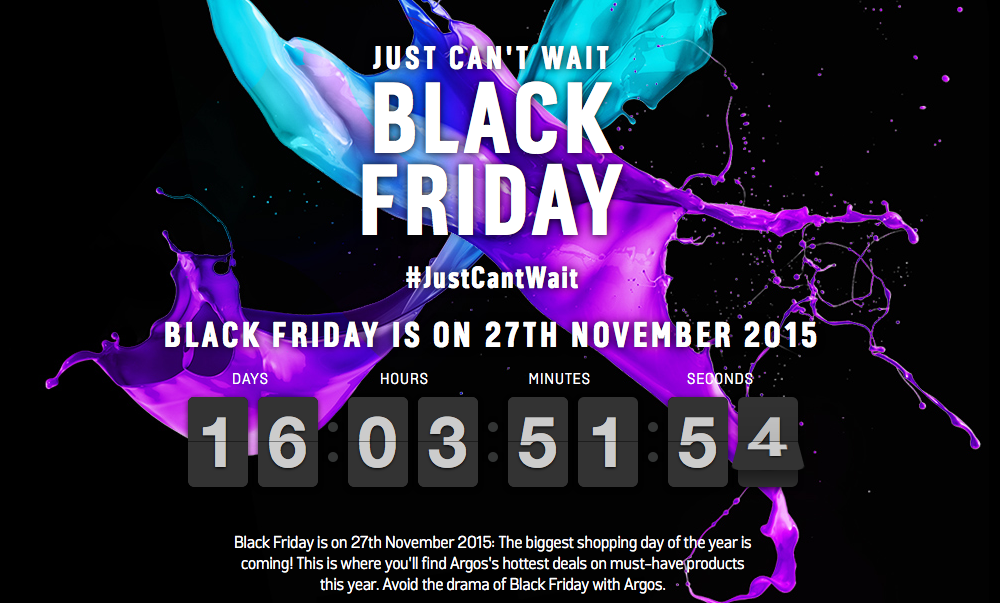
Screen Shot 2015-11-10 at 21.07.59

They are offering to consumers the option to register in order to get “quicker access to our biggest deals and faster in-store collection from our Fast Track counter in-store when you buy online. Plus we’ll hold your item for 7 days, so you can pick it up when convenient.”.  Very good Argos, “Quicker access” means that you’ll get a link to the page and you will have a VIP pass to the site when it will be blocked because it is too busy. That’s the e-version of the stamp at the top of your hand giving you access to the night club. You remember? The queue outside, you have your stamp and you get in and out as many times as you went. Argos will make you a VIP.  Well done Argos, however it would be better to get your capacity planning right so that you don’t need to implement it. Argos, have already given up on delivery though.

Remember that last year the carriers complained that the retailers did not inform them on planned demand. It will be interesting to see whether this year the carriers or the retailers are blaming each other.

The award for the best “we are mastering it” goes to Amazon and John Lewis.

John Lewis

Amazon's site

The two retailers are simply informing their consumers of the dates of Black Friday and also that they already have ongoing promotions. Last year, both retailers delivered both on performance and customer service, with an advantage to John Lewis because they pay all their taxes in the UK and because it is good for the UK economy. Amazon is knowingly applying a tax avoidance strategy, even though things should get better.

Stay tuned…

51.437820 -0.187856

Christmas period was a nightmare for M&S general merchandise.

09 Friday Jan 2015

Posted by Edouard Boris in Black Friday 2014

≈ Leave a comment

Tags

Black Friday, Business Continuity, Business Transformation, Capacity Management, Retail

M&S have conducted their quarter 3 2014/2015 management statement, and the news aren’t good.

Marc Bolland, Chief Executive, said: “We had a difficult quarter in General Merchandise, dominated by unseasonal conditions and an unsatisfactory performance in our e-commerce distribution centre.”

This is the second year in a row that M&S is blaming the weather conditions. (see Q3 2013/2014 press release).

Not a surprise  that M Bolland named their distribution centre as a cause of disruption as the CEO of John Lewis made an allusion to it on Monday.

Blaming the e-commerce distribution centre is not the solution on itself. I recommend M&S to review their entire ecosystem and capacity planning.

Should the retailers adapt their online stock levels to their actual capacity to deliver on time and on quality? Or the other way around, should they adapt their delivery capacity to meet the demand? In other words, does it make sense to sell 100 items when they know that they can deliver only 50 on time and on quality?

More information on Taking orders is great but how about delivering on time and on quality?

51.507351 -0.127758

Xmas John Lewis’ sales tumbled and Black Friday is to be blamed!

07 Wednesday Jan 2015

Posted by Edouard Boris in Digital Transformation, Retail

≈ 1 Comment

Tags

Black Friday, Business Continuity, Capacity Management

We are now starting to get more data of the real impact of the Black Friday retail frenzy.

On the 10 December 2014, I wrote an article about delivery issues that some of the largest retailers faced as a result of Black Friday craziness. I was also interrogative on the real impact on the bottom line Black Friday will have on the entire peak trading period.

image

John Lewis confirmed to the BBC that Black Friday was “more challenging profitability-wise”.

According to the Guardian, John Lewis saw sales fall back 1.4% in Christmas week as sales of electrical goods were pulled forward by the Black Friday promotional weekend.

Furthermore, John Lewis said to the BBC that “online purchases were behind a rise in Christmas sales, despite shop purchases falling over the festive period and like-for-like sales were up 4.8% in the five weeks to December 27 – as store sales dropped around 1%”.

John Lewis boss added “Black Friday is a blessing in the sky as we can achieve record sales online and that our customers can have confidence in the delivery”.

Andy Street made a direct comment on its competitors who weren’t able to deliver as a result of the massive surge in sales:

“it is quite challenging for the rest of the industry as it is pushing all this trading in one day”.    The proportion of sales taken online during one day compared to the entire festive period is a new thing in the UK and the “dependence on fulfillment”.

M Street do not think that the retailers “can put the genie back in the bottle”, however he hopes that next Black Friday won’t be bigger.

Street declared in the Guardian that he believed “John Lewis had outperformed rivals because of its investment in IT and delivery facilities, which meant it was able to meet online orders without any hitches during peak periods, including Black Friday”.

Well done to their Online team, analysts and architects who were able to get the investments and capacity solutions correctly sized and approved. This is pretty impressive when one day web visits were up 300% YoY.

It fair to say that Black Friday ‘effect’ is not as productive as retailers expected. Basically, it sounds that they are selling similar volumes but at a discounted price, hence impacting their profitability.

We are now waiting for Christmas sales data from John Lewis competitors.

Taking orders is great but how about delivering on time and on quality?

10 Wednesday Dec 2014

Posted by Edouard Boris in Digital Transformation, Retail, Risk management

≈ 4 Comments

Tags

Black Friday, Business Continuity, Capacity Management

In my last post I wrote about the issues that some of the large retailers had, in order to cope with the online demand on Black Friday. I also questioned the ability of the same retailers to deliver on time.

It was reported that M&S was Hit By Pre-Christmas Online Delivery Delays and that  “share price has fallen 3% as investors fear overall sales will be affected”.

Unfortunately, M&S aren’t an isolated case, as written by Zoe Wood in the Guardian, Christmas shopping surge puts retailers under strain online. In this article, we learn that Tesco Direct, Debenhams, and many other retailers are trying to clear the backlog of orders whilst impacting the delivery date of new orders.

Taking in consideration the entire commerce chain, including delivering on the retailer’s commitments:

Should the retailers be taking orders when they can’t deliver one time ?

A purchase isn’t just made of the item sold. Especially when everyone can compare online. The product is made of the online experience, the quality of the communication during the sale process until and after delivery, the delivery itself (timing, product condition, item missing) and the after sale services such as customer services and guarantee (for example John Lewis offers free extension guarantees).

Should the retailers adapt their online stock levels to their actual capacity to deliver on time and on quality? Or the other way around, should they adapt their delivery capacity to meet the demand? In other words, does it make sense to sell 100 items when they know that they can deliver only 50 on time and on quality?. Customers get frustrated.

The question is, would you accept as a customer to be informed during the online shopping process that your items can’t be delivered in store on time, potentially too late for xmas? Or is it an accepted inconvenience that the rebate offsets?

They are  number of lessons to be learnt from the Black Friday and Cyber Monday sales.  In particular, the operating costs incurred in order to minimise the delivery delays, coupled with the reduced margin and the impact on the delivery chain during the following days and weeks.

Overall, £810m was spent online just on Black Friday. It will be interesting  to know the total amount spent online until Christmas, hence the real impact on the bottom line for the entire peak trading period.

Black Friday

01 Monday Dec 2014

Posted by Edouard Boris in Black Friday 2014

≈ Leave a comment

Tags

Black Friday, Business Continuity, Capacity Management, Service Management

image

According to the BBC, Amazon’s “website recorded orders for more than 5.5 million goods, with about 64 items sold per second.”

Meanwhile, Tesco direct, Argos, Currys and John Lewis implemented queuing on their site.

On Tesco Direct, the queuing technic involved a rolling 30-second period when your browser would try to access the site. If unsuccessful, the browser would start yet an other 30-second period.

image

Argos had simply put an holding page up, informing their customers of the massive traffic and asking them to try again.

image

In the case of Tesco Direct and of Argos, the tactic used was aimed at mitigating the customer’s experience already on the site.

Basically, the retailers  implemented an e-bouncer at the entrance to ensure that if you were lucky enough to be on the online shop, you could still move around and buy stuff. And if you were kept outside of the online shop, you would have to wait for someone to get out of the shop first before being allowed to get in.

The objective is to avoid that the entire online shop collapses and then no sales could be processed.

This tactic is required when the demand exceeds the technical capacities (software, infrastructure, network) of the online shop.

Meanwhile Amazon had put in place a smart demand management. The deals were opened for a period of time, openly communicated, informing customers of the remaining stock level, and offering a wait list when not full.

image

image

Throwing more tin into the mix or e-bouncing shoppers is not the only answer and Amazon got it.  They developed a control demand strategy coupled with great marketing. Well-done Amazon.

The question is whether all  orders will be delivered on time. Some retailers have already extended the delay when you buy online and collect in store.

In my opinion, all these technical glitches are far less terrible than the events in stores. As Barbara Ellen wrote in The Observer, Sunday 30 November 2014: “The Black Friday shopping scrums are so shaming”.

Follow Ed Boris on WordPress.com

Recent posts

  • La vie du Colonel Edmond Robert Lévêque et de Marguerite Lévêque June 10, 2023
  • What most CIOs and CMOs miss when they negotiate their SaaS SLA. January 21, 2021
  • Ethic, Business, Politics and Global Warming September 16, 2018

Tags

agile Airport Chaos Architecture Design Black Friday Business Continuity Business Transformation Capacity Management capacity planning change cloud Incident Management Integrations Linkedin NATS payment PCI Planned Obsolescence post mortem Retail saas security service delivery service design Service Management service strategy Social Social media Software Design

Categories

  • Agile
  • Black Friday 2014
  • Business Continuity
  • Business Ethic
  • Cloud
  • Cyber
  • Data Science
  • Digital Transformation
  • Financing Decision
  • Innovation
  • New Trends
  • Open Compute Project
  • Payment
  • Retail
  • RightSourcing
  • Risk management
  • SAAS
  • Security
  • SmartSourcing
  • Social
  • Talent Management
  • Uncategorized

Archives

  • June 2023
  • January 2021
  • September 2018
  • June 2017
  • March 2017
  • April 2016
  • November 2015
  • January 2015
  • December 2014
  • October 2014
  • July 2014
  • June 2014
  • May 2014
  • March 2014

Blog at WordPress.com.

  • Subscribe Subscribed
    • Ed Boris
    • Already have a WordPress.com account? Log in now.
    • Ed Boris
    • Subscribe Subscribed
    • Sign up
    • Log in
    • Report this content
    • View site in Reader
    • Manage subscriptions
    • Collapse this bar
 

Loading Comments...
