• About Ed Boris
  • Contact details
  • Linkedin Profile

Ed Boris

~ Expert in digital transformation

Ed Boris

Tag Archives: Capacity Management

British Airways Technology Chaos, really caused by a power surge?

18 Sunday Jun 2017

Posted by Edouard Boris in Business Continuity, Cloud, Innovation, SAAS

≈ Leave a comment

Tags

Capacity Management, Incident Management, Service Management

Most people are questioning the BA’s version on how their entire Information System went down on  May 27th 2017, impacting 75,000 passengers for up to 48 hours and will cost up to £80m.

British Airways states that a human error caused by an engineer who disconnected a power supply cable trigerred major outage due to  a power surge.
The question is how a such outage lasted so long? The “power surge” term is misleading, because most people will think power in terms of electricity  as opposed to Information Ecosystem.
In terms of Service Outage Communication, the challenge is to inform without revealing some embarrassing facts, the challenge is to partially say the truth without lying. In this instance, I must admit that BA is doing a good job.
My theory is that BA’s system crashed as a result of the power outage, but BA’s team did not restart the entire ecosystem in sequence. My assumption is that BA’s system were all restarted simultaneously causing what they have called the “power surge“. The question is whether BA had a datacenter restart runbook, or not, and whether if the required documentation existed, whether it was ever tested.
Complex ecosystems require to restart key Infrastructure components, but following a pre-established sequence. For example, the core storage first, then database cashing infrastructure followed by database systems, this is even more true with architectures based on microservices.
In other words, backend systems should be restarted first followed by frontends. If you do not follow a pre-established sequence, the different components of the ecosystems will randomly resume they operations and start “talking” and expect answers. When a non synchronised datacenter restart is performed,   It is likely to end up with data corruption. Furthermore, as the front-end caching infrastructure is not warm, the backend will crash under the load, preventing the reopening of services.
If this scenario happened at BA, the databases storing flight reservations, flight plans and customer details got corrupted up to a point where it became impossible to resume their operations from the second datacentre, also now partially corrupted as a result of the active-active synchronisation performed in between the two datacenter.

British Airways had then no other options than to restore backups and then replay system logs of unsynchronised systems, and then only resume synchronisations with the second datacenter.

Obviously, this is a much more difficult reality to explain, but I talked to several IT experts and no-one, absolutely nobody is buying the power surge story.
I’m looking forward to hearing from the internal investigation that BA’s chief executive has already launched.

Get Ready because Black Friday this year is going to be Bloody Friday.

11 Wednesday Nov 2015

Posted by Edouard Boris in Business Continuity, Cloud, Digital Transformation, SAAS, SmartSourcing

≈ Leave a comment

Tags

Black Friday, Capacity Management, Retail, saas

All the major retailers in the UK are prepared and are announcing their Black Friday super productions:

The Award for the Best Comedy goes to Tesco!

Screen Shot 2015-11-10 at 21.08.37

Last year I wrote a post on “Taking orders is great but how about delivering on time and on quality?”. It is pretty hilarious but Tesco have already given up.

They announce that “Due to unexpected high demand all deliveries will take 5-7 days” and “Express delivery is currently unavailable”.

No, you are not dreaming, today 11th November, 16 days before Black Friday, Tesco are informing us that “Due to unexpected demand” they can’t deliver on time. Tesco is officially inventing a new concept: The Unexpected Expected High Demand, LoL. For a company breathing Customer Satisfaction, this is very interesting. Basically, Tesco has made the decision not to invest in sufficient capacity on the front and back office. They will be, knowingly, selling beyond their firm value chain capacity.

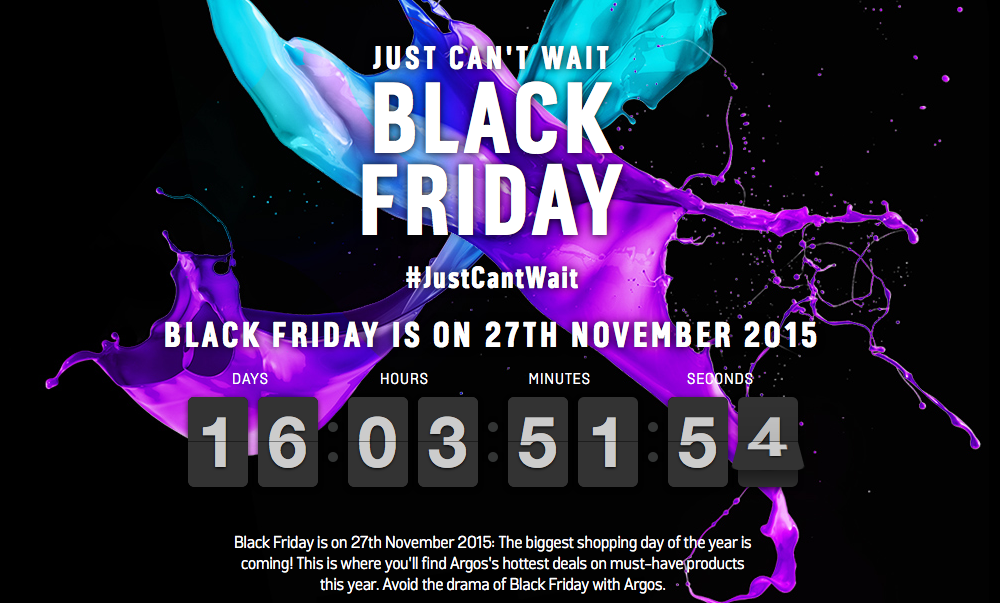
The award for the Best Customer engagement goes to Argos.co.uk.

Screen Shot 2015-11-10 at 21.07.59

They are offering to consumers the option to register in order to get “quicker access to our biggest deals and faster in-store collection from our Fast Track counter in-store when you buy online. Plus we’ll hold your item for 7 days, so you can pick it up when convenient.”.  Very good Argos, “Quicker access” means that you’ll get a link to the page and you will have a VIP pass to the site when it will be blocked because it is too busy. That’s the e-version of the stamp at the top of your hand giving you access to the night club. You remember? The queue outside, you have your stamp and you get in and out as many times as you went. Argos will make you a VIP.  Well done Argos, however it would be better to get your capacity planning right so that you don’t need to implement it. Argos, have already given up on delivery though.

Remember that last year the carriers complained that the retailers did not inform them on planned demand. It will be interesting to see whether this year the carriers or the retailers are blaming each other.

The award for the best “we are mastering it” goes to Amazon and John Lewis.

John Lewis

Amazon's site

The two retailers are simply informing their consumers of the dates of Black Friday and also that they already have ongoing promotions. Last year, both retailers delivered both on performance and customer service, with an advantage to John Lewis because they pay all their taxes in the UK and because it is good for the UK economy. Amazon is knowingly applying a tax avoidance strategy, even though things should get better.

Stay tuned…

51.437820 -0.187856

Christmas period was a nightmare for M&S general merchandise.

09 Friday Jan 2015

Posted by Edouard Boris in Black Friday 2014

≈ Leave a comment

Tags

Black Friday, Business Continuity, Business Transformation, Capacity Management, Retail

M&S have conducted their quarter 3 2014/2015 management statement, and the news aren’t good.

Marc Bolland, Chief Executive, said: “We had a difficult quarter in General Merchandise, dominated by unseasonal conditions and an unsatisfactory performance in our e-commerce distribution centre.”

This is the second year in a row that M&S is blaming the weather conditions. (see Q3 2013/2014 press release).

Not a surprise  that M Bolland named their distribution centre as a cause of disruption as the CEO of John Lewis made an allusion to it on Monday.

Blaming the e-commerce distribution centre is not the solution on itself. I recommend M&S to review their entire ecosystem and capacity planning.

Should the retailers adapt their online stock levels to their actual capacity to deliver on time and on quality? Or the other way around, should they adapt their delivery capacity to meet the demand? In other words, does it make sense to sell 100 items when they know that they can deliver only 50 on time and on quality?

More information on Taking orders is great but how about delivering on time and on quality?

51.507351 -0.127758

Xmas John Lewis’ sales tumbled and Black Friday is to be blamed!

07 Wednesday Jan 2015

Posted by Edouard Boris in Digital Transformation, Retail

≈ 1 Comment

Tags

Black Friday, Business Continuity, Capacity Management

We are now starting to get more data of the real impact of the Black Friday retail frenzy.

On the 10 December 2014, I wrote an article about delivery issues that some of the largest retailers faced as a result of Black Friday craziness. I was also interrogative on the real impact on the bottom line Black Friday will have on the entire peak trading period.

image

John Lewis confirmed to the BBC that Black Friday was “more challenging profitability-wise”.

According to the Guardian, John Lewis saw sales fall back 1.4% in Christmas week as sales of electrical goods were pulled forward by the Black Friday promotional weekend.

Furthermore, John Lewis said to the BBC that “online purchases were behind a rise in Christmas sales, despite shop purchases falling over the festive period and like-for-like sales were up 4.8% in the five weeks to December 27 – as store sales dropped around 1%”.

John Lewis boss added “Black Friday is a blessing in the sky as we can achieve record sales online and that our customers can have confidence in the delivery”.

Andy Street made a direct comment on its competitors who weren’t able to deliver as a result of the massive surge in sales:

“it is quite challenging for the rest of the industry as it is pushing all this trading in one day”.    The proportion of sales taken online during one day compared to the entire festive period is a new thing in the UK and the “dependence on fulfillment”.

M Street do not think that the retailers “can put the genie back in the bottle”, however he hopes that next Black Friday won’t be bigger.

Street declared in the Guardian that he believed “John Lewis had outperformed rivals because of its investment in IT and delivery facilities, which meant it was able to meet online orders without any hitches during peak periods, including Black Friday”.

Well done to their Online team, analysts and architects who were able to get the investments and capacity solutions correctly sized and approved. This is pretty impressive when one day web visits were up 300% YoY.

It fair to say that Black Friday ‘effect’ is not as productive as retailers expected. Basically, it sounds that they are selling similar volumes but at a discounted price, hence impacting their profitability.

We are now waiting for Christmas sales data from John Lewis competitors.

Airport chaos – The inquiry terms explained

06 Tuesday Jan 2015

Posted by Edouard Boris in Business Continuity, Digital Transformation, Innovation

≈ Leave a comment

Tags

Capacity Management, Incident Management, post mortem, service delivery, Service Management

This post is the second part of the airport chaos.

The inquiry terms explained.

The terms are listed over 5 bullet points requiring some clarifications from a Service Management perspective :

1. Root cause of the incident:

Basically getting down to the bottom of what happened and in particular determining the context which created the conditions leading eventually to the service interruption.  A good analogy would be the analysis performed by firefighters after a blaze. Let’s say that, several people were killed by the smoke (cause of the death), however the root cause of the fire could have been a short-circuit in a multi-socket adaptor due for example, by a human error (too many high-hungry appliances being plugged on the same socket).

Special attention will need to be given to recent changes (change management including change control) which may have occurred over the last circa 30 days prior to the incident.

This process is often called ‘Post Mortem’, I understand that in this type of industry, the term wasn’t used.

2. Incident management:

The CAA will need to look at how the incident was handled. From an IT management perspective, it should cover Incident occurrence, System monitoring (Incident detection & Incident reporting), Service stable, service All Clear, and finally Incident communication throughout service restoration. It should also cover whether any of the different phases could have been handled quicker.

3. Problem management (Part 1) i.e lessons learned from the previous incident (December 2013) and in particular whether all the action items listed as part of the previous incident analysis were properly closed and whether any of the root cause(s) of the 2013 incident played any role in the 2014 one.

4. Business continuity plan & capacity planning: “A review of the levels of resilience and service that should be expected across the air traffic network taking into account relevant international benchmarks”.

This is interesting given the communication made by NATS that the “back-up plans and procedures worked on Friday exactly as they were designed to”. 

5. Problem management (Part 2) “Further measures to avoid technology or process failures in this critical national infrastructure”:

Basically putting together a plan to resolve (as opposed to mitigate) all underlying causes and root causes which led to the chaos. Note that this plan will be reviewed during the next incident investigation (see Problem Management part 1).

In addition to completing the problem management, NATS have requested that CAA put together a plan addressing the new requirements listed in the upcoming Business Continuity plan “Further measures to reduce the impact of any unavoidable disruption”.

In this case, they will be considering not only the actions required to prevent a similar incident from occurring again but also the actions required to address the other risks they will identify during the root cause analysis. Furthermore, they will put together a plan to increase the resiliency and business continuity (see capacity management) during major outages, considering Recovering Point Objective.

The CAA is expecting to publish the report by the 29 March 2015.

Airports chaos: Why the service impact lasted 16,000 minutes rather than 45 minutes as initially reported.

05 Monday Jan 2015

Posted by Edouard Boris in Business Continuity, Cloud, Cyber, Digital Transformation, RightSourcing

≈ 1 Comment

Tags

Airport Chaos, Business Transformation, Capacity Management, capacity planning, NATS, post mortem, service delivery, service design, Service Management, service strategy

I’m following up on my last post (read for full details) about the Airport chaos which occurred on the 12th of December 2014 at Swanwick air traffic control centre.

What happened?

NATS, the UK-based global air traffic management company declared that system was back up and running 45 minutes after the event the failure.

An independent inquiry.

On the 15.12.14, NATS declared that the UK Civil Aviation Authority (CAA) will carry out “an independent inquiry following the disruption caused by the failure in air traffic management systems”.

On the NATS’ web site, there is only a mention of the high level plan of the independent inquiry (I’ll explain it in a new post tomorrow). However, drilling down into the CAA’s web site, I was able to find the inquiry terms of reference.

Timelines of events and service impacts.

As provided by the CAA, this is where it gets interesting:

1. Service outage started at approximately 1515 GMT.  Following “the fault in a primary and back-up system led to a failure in the flight data server in the Area Control (AC) Operations Room”.

2. Service restoration starts : “Restrictions were gradually lifted from approximately 1605 GMT with a rapid recovery to full capacity by the middle of the Friday evening”.

This is not a precise timing, however the CAA provides more insights on the true service impact.

The CAA confirms that “Delays and cancellations were incurred totalling some 16,000 MINUTES”. The 45 minutes initially reported represented only system downtime, not service impact measured from a business perspective.

imageimage

“Airlines cancelled around 80 flights: estimated to be 2,000 minutes as a consequence of the restrictions put in place to manage traffic”.

Furthermore, 14,000 minutes  as “result of the phased recovery to prevent overloads and takes account of ground congestion at the major airports”.

“Overall around 450 aircraft were delayed of the 6,000 handled on the 12 December and the average delay to the 450 flights was approximately 45 minutes”.

The CAA reminds us that a “failure affecting the same operations room at Swanwick on 7 December 2013, which resulted in total delay amounting to 126,000 minutes and which impacted 1,412 flights and the cancellation of 300”.

NATS made a mistake by not communicating the progress made over the full service recovery and eventually on the total impact on service uptime.

Service Performance.

Remember that no one cares whether your servers are up and running when no one, or only some of your customers can access your IT services, for example SAP, email, document management, internet corporate site or ecommerce site. This is the same here, systems were up but aircraft could not take off and passengers were badly impacted.

Your service performance should always be measured as being perceived from your customer’s point of view, not from a piece of infrastructure being up perspective.

A service is very rarely operating in isolation, it operates within an echo system made of your own capabilities and what your suppliers and partners are delivering within this ecosystem. Did the hotels and restaurants  have enough vacancies to welcome the passengers?

Once services have been restored, everyone should be concerned by  customers  still suffering from the consequences, such as holidays cancelled (and potentially not reimbursed) or as after Black Friday (see my post) when the products were delivered after Christmas, long after services being actually restored and stable. Will the actual whole cost of the outage at the Swanwick air traffic control centre be ever known? I doubt.

However, NATS has already announced that “there will be a financial consequence for the company from the delay caused. Under the company’s regulatory performance regime, customers will receive a rebate on charges in the future”.

Capacity management.

The NATS managing director of Operation declared during the incident resolution: “These things are relatively rare. We are a very busy island for air traffic control, so we’re always going to be operating near capacity ”.

This is a very concerning statement. Getting service impacted by shortage in capacity is not uncommon (I’m not saying it is satisfactory) when either capacity requirements aren’t properly expressed by the business, or, when the same requirements aren’t adequately translated into efficient technical design. However, it is the responsibility of the CIO to properly and efficiently document and communicate the risks incurred by potential shortage in capacity.

Vince cable declared that the incident have been caused by lack of IT investments. Well, the question is now whether the investments were submitted and refused. The inquiry will need to determine whether the risks of running “at capacity” were properly communicated to the board.

The CAA is expecting to publish the report by the 29 March 2015.

Taking orders is great but how about delivering on time and on quality?

10 Wednesday Dec 2014

Posted by Edouard Boris in Digital Transformation, Retail, Risk management

≈ 4 Comments

Tags

Black Friday, Business Continuity, Capacity Management

In my last post I wrote about the issues that some of the large retailers had, in order to cope with the online demand on Black Friday. I also questioned the ability of the same retailers to deliver on time.

It was reported that M&S was Hit By Pre-Christmas Online Delivery Delays and that  “share price has fallen 3% as investors fear overall sales will be affected”.

Unfortunately, M&S aren’t an isolated case, as written by Zoe Wood in the Guardian, Christmas shopping surge puts retailers under strain online. In this article, we learn that Tesco Direct, Debenhams, and many other retailers are trying to clear the backlog of orders whilst impacting the delivery date of new orders.

Taking in consideration the entire commerce chain, including delivering on the retailer’s commitments:

Should the retailers be taking orders when they can’t deliver one time ?

A purchase isn’t just made of the item sold. Especially when everyone can compare online. The product is made of the online experience, the quality of the communication during the sale process until and after delivery, the delivery itself (timing, product condition, item missing) and the after sale services such as customer services and guarantee (for example John Lewis offers free extension guarantees).

Should the retailers adapt their online stock levels to their actual capacity to deliver on time and on quality? Or the other way around, should they adapt their delivery capacity to meet the demand? In other words, does it make sense to sell 100 items when they know that they can deliver only 50 on time and on quality?. Customers get frustrated.

The question is, would you accept as a customer to be informed during the online shopping process that your items can’t be delivered in store on time, potentially too late for xmas? Or is it an accepted inconvenience that the rebate offsets?

They are  number of lessons to be learnt from the Black Friday and Cyber Monday sales.  In particular, the operating costs incurred in order to minimise the delivery delays, coupled with the reduced margin and the impact on the delivery chain during the following days and weeks.

Overall, £810m was spent online just on Black Friday. It will be interesting  to know the total amount spent online until Christmas, hence the real impact on the bottom line for the entire peak trading period.

Black Friday

01 Monday Dec 2014

Posted by Edouard Boris in Black Friday 2014

≈ Leave a comment

Tags

Black Friday, Business Continuity, Capacity Management, Service Management

image

According to the BBC, Amazon’s “website recorded orders for more than 5.5 million goods, with about 64 items sold per second.”

Meanwhile, Tesco direct, Argos, Currys and John Lewis implemented queuing on their site.

On Tesco Direct, the queuing technic involved a rolling 30-second period when your browser would try to access the site. If unsuccessful, the browser would start yet an other 30-second period.

image

Argos had simply put an holding page up, informing their customers of the massive traffic and asking them to try again.

image

In the case of Tesco Direct and of Argos, the tactic used was aimed at mitigating the customer’s experience already on the site.

Basically, the retailers  implemented an e-bouncer at the entrance to ensure that if you were lucky enough to be on the online shop, you could still move around and buy stuff. And if you were kept outside of the online shop, you would have to wait for someone to get out of the shop first before being allowed to get in.

The objective is to avoid that the entire online shop collapses and then no sales could be processed.

This tactic is required when the demand exceeds the technical capacities (software, infrastructure, network) of the online shop.

Meanwhile Amazon had put in place a smart demand management. The deals were opened for a period of time, openly communicated, informing customers of the remaining stock level, and offering a wait list when not full.

image

image

Throwing more tin into the mix or e-bouncing shoppers is not the only answer and Amazon got it.  They developed a control demand strategy coupled with great marketing. Well-done Amazon.

The question is whether all  orders will be delivered on time. Some retailers have already extended the delay when you buy online and collect in store.

In my opinion, all these technical glitches are far less terrible than the events in stores. As Barbara Ellen wrote in The Observer, Sunday 30 November 2014: “The Black Friday shopping scrums are so shaming”.

Follow Ed Boris on WordPress.com

Recent posts

  • La vie du Colonel Edmond Robert Lévêque et de Marguerite Lévêque June 10, 2023
  • What most CIOs and CMOs miss when they negotiate their SaaS SLA. January 21, 2021
  • Ethic, Business, Politics and Global Warming September 16, 2018

Tags

agile Airport Chaos Architecture Design Black Friday Business Continuity Business Transformation Capacity Management capacity planning change cloud Incident Management Integrations Linkedin NATS payment PCI Planned Obsolescence post mortem Retail saas security service delivery service design Service Management service strategy Social Social media Software Design

Categories

  • Agile
  • Black Friday 2014
  • Business Continuity
  • Business Ethic
  • Cloud
  • Cyber
  • Data Science
  • Digital Transformation
  • Financing Decision
  • Innovation
  • New Trends
  • Open Compute Project
  • Payment
  • Retail
  • RightSourcing
  • Risk management
  • SAAS
  • Security
  • SmartSourcing
  • Social
  • Talent Management
  • Uncategorized

Archives

  • June 2023
  • January 2021
  • September 2018
  • June 2017
  • March 2017
  • April 2016
  • November 2015
  • January 2015
  • December 2014
  • October 2014
  • July 2014
  • June 2014
  • May 2014
  • March 2014

Blog at WordPress.com.

  • Subscribe Subscribed
    • Ed Boris
    • Already have a WordPress.com account? Log in now.
    • Ed Boris
    • Subscribe Subscribed
    • Sign up
    • Log in
    • Report this content
    • View site in Reader
    • Manage subscriptions
    • Collapse this bar
 

Loading Comments...